HIGH
FIRE DANGER

Weather

Harris County ESD 16, Klein Fire Department protects and serves our community by minimizing the loss of life or property from fire, medical or other emergencies. We strive to meet and exceed the needs and expectations of our community and our response partners. Every day. Every way. Every one
ASSESSING THE KLEIN COMMUNITY’S NEEDS, ONE RESIDENT AT A TIME.
Our Story and Our Mission
Our story began in 1951, when a handful of neighbors in Klein saw a need and stepped up to protect their community. With little more than determination and a shared sense of responsibility, these volunteers laid the foundation for what would become the Klein Fire Department. Over the decades, as our community grew from quiet neighborhoods in farmland into a thriving part of northern Harris County, we grew too—expanding our services, training, and resources to meet the needs of the people we serve.
Today, under Harris County Emergency Services District 16, the Klein Fire Department proudly covers a 49-square-mile area, responding to thousands of calls each year. From house fires to medical emergencies, from rescuing families in distress to supporting disaster recovery, our mission remains the same: to protect life and property with courage, honor, and integrity.
What makes us unique isn’t just our history—it’s our connection to the community. Our firefighters and first responders are your neighbors, friends, and family members. We are guided by a locally elected board that ensures accountability and transparency, and we operate under the laws of the State of Texas to keep Klein safe and prepared for whatever challenges come our way.
Why This Assessment Matters
Klein is growing—and with growth comes new challenges. More homes, more businesses, more traffic, and more people mean greater demands on emergency services. Our motto says it best: “Klein is growing, keep safety growing faster.” This Community Needs Assessment is our way of listening, learning, and planning for the future. It’s not just about fire trucks and equipment—it’s about understanding what our community needs to stay safe and prepared.
Your Voice Matters
We can’t do this alone. Your input helps us identify priorities, improve response times, and ensure that every family, school, and business in Klein has the protection they deserve. Together, we can build a safer, stronger community.
Thank you for being part of this journey. Let’s keep safety growing faster—together.

Growth is calling. We must answer.
Our Story and Our Mission
Klein isn’t the same community it was 10 or even 5 years ago—and that’s a good thing! Families are moving in, businesses are thriving, and new neighborhoods are popping up everywhere. But with growth comes responsibility. More people means more calls for help, and our fire department is answering more emergencies than ever before.
In 2021, we responded to 3,469 calls for service. Last year? 6,070 calls— that’s a 75% increase in 5 years! And it’s not just the calls. Our population has soared past 200,000 residents, with thousands of new apartments and homes built since 2015 and more on the way. Every new street, school, and business adds to the demand for fast, reliable emergency response.
We’ve worked hard to keep up—adding full-time firefighters, upgrading equipment, and improving training. Our average response time has dropped from 10 minutes in 2015 to about 6½ minutes today, thanks to 24/7 staffing at all eight stations. These improvements help us maintain an ISO 2 rating from the Insurance Sevices Office, which can lead to lower homeowners’ insurance costs.
But here’s the challenge: while Klein is growing, our funding hasn’t kept pace. Fire trucks that cost $375,000 in 2010 now cost over $1.3 million, and by 2030, prices will climb even higher. The same goes for gear, technology, and training. We’ve stretched every dollar to serve you well, but the math is clear—our community’s growth is outpacing our resources.
That’s why this Community Needs Assessment matters. It’s about planning ahead so we can keep safety growing faster than Klein. Your input will help us make smart decisions about staffing, equipment, and emergency response for the future.
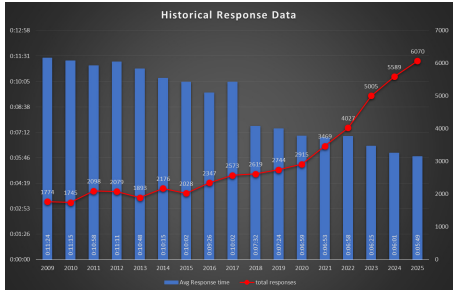
Historic Call Volume & Response Times
That is a 248% increase in calls for service in 15 years!
• Average Response Time:
Why it matters: Faster response times save lives and property. We’ve worked hard to improve, but growth means we need to keep pace.
Public Safety & Population Growth
Impact: More people = more calls, more traffic, and more need for emergency services.
What We’ve Accomplished So Far
The Challenge Ahead
Fire truck costs have skyrocketed:
• 2010: Pumper = $375K | Ladder = $500K
• 2024: Pumper = $1.3M Ladder = $2.2M
• By 2030, costs will rise another 30% (a 370% increase since 2010!)
Did You Know?
Protecting Klein Community’s Future
Challenges Posed by Aging Infrastructure and Rising Costs
Our current revenue is unable to support the present level of service going forward. ESD 16 faces significant challenges due to its aging infrastructure, including fire stations and emergency apparatus. At the same time, we are experiencing increased costs across all aspects of our operations. More than 80% of our current revenue is allocated to staffing and related expenses. This allocation means that, without additional funding, we will not be able to maintain staffing at all eight fire stations in the future.
This situation is especially concerning as our annual call volume continues to rise, and the emergencies we respond to are becoming more complex. Our crews are dispatched to a wide range of incidents, from structure fires and aircraft emergencies to natural disasters and medical crises such as overdoses and cardiac events. The demand for our services has never been higher.
In addition, maintaining a low ISO rating—which helps determine local property insurance costs—depends on our ability to provide highly trained personnel, maintain modern equipment, and ensure rapid response times. Without sufficient resources, our capacity to meet these critical standards and protect our community’s safety is at risk.
Current Funding Limits
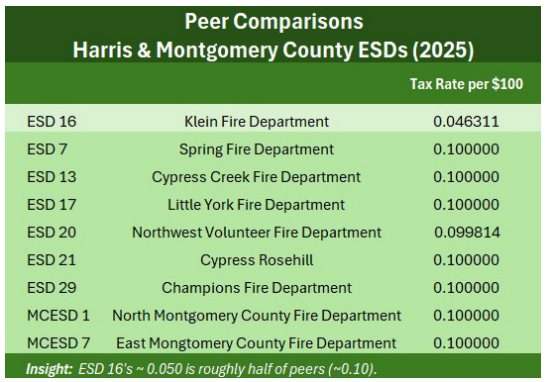
Harris County ESD 16, Klein Fire Department is funded primarily through property taxes. By state law, Texas Emergency Services Districts can levy a maximum of $0.10 for every $100 of property value. Despite responsible fiscal management, the surging costs associated with staffing, apparatus, fuel, and technology have outpaced the revenue generated primarily through property taxes. With the district’s tax rate at approximately $0.05 per $100 of property valuation—half of the legal limit and significantly lower than all neighboring districts—the resources required to maintain our existing emergency services are no longer sustainable. The recent introduction of debt service in 2025 to keep pace with growth further emphasizes the strain on our budget and the urgent need to address this funding shortfall.
The Importance of an Adjustment
Securing Our Community’s Future: Next Steps
A modest tax-cap adjustment will allow us to:
Ensuring Trust Through Transparent and Accountable Actions
We are dedicated to upholding the highest standards of transparency and accountability in every aspect of our operations. To foster trust within our community, we make all budgets, audits, and tax notices readily available for public review. This open access ensures that residents can see exactly how resources are allocated and used to support emergency services.
Any proposed increase will strictly adhere to Texas Truth-in-Taxation laws, including conducting public hearings to gather input and address concerns, and, when necessary, seeking voter approval before any changes are implemented. These steps are taken to make sure that the community remains fully informed and involved in decisions that impact funding for emergency services.
Protecting What Matters Most: Your Safety Comes First
Every dollar invested in emergency services saves both lives and property. As our community continues to grow, it is essential to provide firefighters and paramedics with the resources they need to protect you and your family.
As we look to the future, we know that the strength of our department depends on understanding the needs of the people we serve. That’s why this Community Needs Assessment matters. It’s more than a report—it’s a conversation about how we can continue to protect and support Klein together. Thank you for being part of this journey. Let’s keep safety growing faster—together.